


Distracting websites do more than steal a few minutes. They interrupt your study rhythm, split your attention across tabs, and leave you rereading the same paragraph because your brain keeps replaying what you just scrolled. Even short checks add up: you lose time in the moment, then lose more time getting back to where you were. That stop-start pattern makes studying feel harder than it should, and this often leads to procrastination or quitting early.
Blocking sites inside Chrome helps because it changes what happens at the exact point of temptation. Instead of negotiating with yourself, the browser simply prevents the detour, so you stay with the assignment long enough to build momentum. When the rule is automatic, your sessions become more consistent, your breaks become intentional, and you finish with measurable progress rather than half-completed tasks.
If you are looking up how to block websites on Chrome for studying, think of it as environment design: remove the triggers that pull you away, keep the learning resources you need available, and use schedules that match your study hours. You also reduce context switching, which makes it easier to enter and sustain a productive flow. Over time, that setup supports better focus, stronger retention, and improved results on exams and deadlines.
How to block websites on Chrome for studying using Blocksite
BlockSite is a browser-based tool that helps you limit online distractions by restricting access to websites you choose. Below are practical steps you can set up quickly, then rely on day to day.
1. Use Blocksite extension
Start by adding the BlockSite browser extension to Chrome, then open its dashboard. This puts your controls in the same place you already study, so you do not need a separate workflow to stay on track.
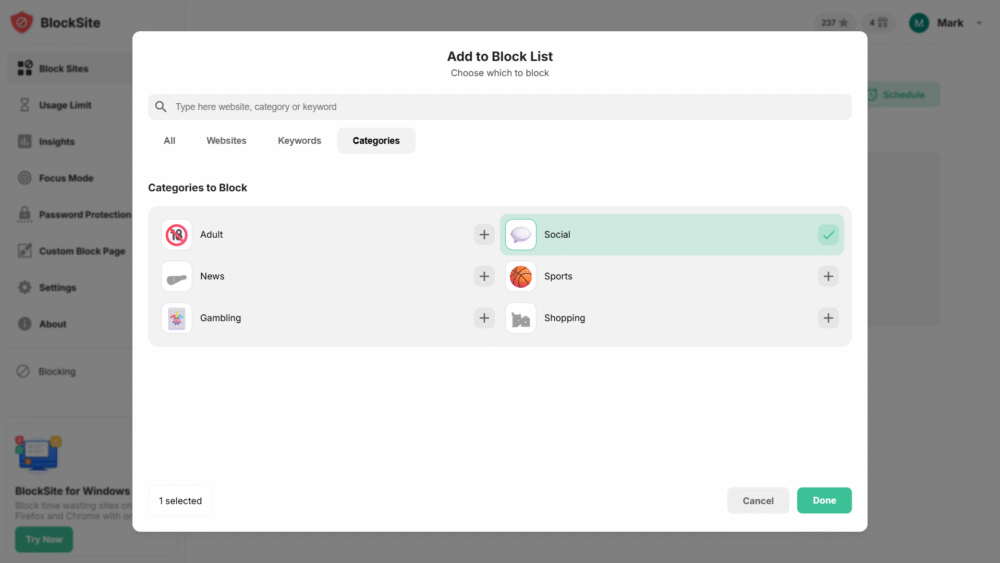
Think of it as a site blocker that sits quietly in the background. Once your rules are set, you should not have to keep making willpower decisions mid-session.
2. Block specific distracting sites (social media, streaming, gaming)
Open your Block List and add the sites that reliably pull you off task. For most students, that list usually includes social media (to block TikTok, Facebook, etc), video streaming, forums, and gaming related pages.
Two BlockSite features are especially useful here:
- Block List: Add specific URLs you want to avoid during study time.
- Category blocking: If your distractions come in patterns, you can block whole categories like entertainment, social media, or gaming, instead of playing whack-a-mole with individual sites.
A useful mindset: do not try to block everything on day one. Start with the top three sites that cause the biggest “I lost an hour” problem, then expand your list based on what actually derails you.
3. Set study-time schedules
Your blocker is far more effective when it turns on automatically. Use scheduling to match your real routine, for example:
- Weeknights: block distractions during your usual homework hours
- Weekends: block during a morning deep-study block
- Short sprints: align blocks with 25 to 50 minute focus intervals, followed by a planned break
This matters because the moment you “feel like studying” is rarely the moment you need protection. The risk is highest when you are tired, bored, or stuck. Scheduling makes the protection show up before your attention slips.
If your study includes a small set of allowed resources, Focus Mode can be paired with scheduling so that during your study window, only approved sites remain accessible.
4. Prevent access during exams or focus sessions
For high-stakes sessions, raise the barrier by switching from “block a few sites” to “allow only what I need.”
Use Focus Mode (sometimes paired with a whitelist) to restrict browsing to a short list of approved study sites. This is ideal when you want to avoid accidental detours during:
- Timed practice exams
- Writing assignments that require long, uninterrupted attention
- Revision sessions where your goal is repetition and recall, not browsing
If you want to keep your momentum even when a temptation pops up, Redirects can help. Instead of landing on a blocked page and feeling frustrated, you can route that click to something study-friendly, like a reference page or a learning resource you already use. That turns a weak moment into a recovery, not a full derail.
Optional add-on for self-awareness: Insights can show where your time is going online. If you think you are only “checking a site for a minute,” this kind of tracking makes the pattern visible, so you can adjust your blocks based on reality, not guesswork.
Why blocking websites helps you study better
Blocking is not about being strict for the sake of it. These are the advantages students usually feel first, and why the habit sticks.
1. Reduces distractions and procrastination
Distractions are not only time loss, they are attention loss. Every time you switch to a distracting site, your brain has to rebuild context when you return. Blocking removes the easiest escape hatch, especially when you hit a hard paragraph or a confusing problem set.
The result is fewer “false breaks.” You still take breaks, but they are intentional, not accidental.
2. Improves concentration and retention
Concentration is easier when your environment is predictable. When you know certain sites are unavailable during study time, you stop negotiating with yourself, and you stay with the material long enough for it to sink in.
This has a direct effect on retention:
- You spend longer in a single cognitive mode, instead of bouncing between entertainment and learning
- You get more repetitions on key concepts because you are not restarting every few minutes
- You complete more full study cycles, which supports recall later
This is especially noticeable with tasks that require buildup, like math, coding, writing, or memorization.
3. Encourages consistent study habits
The biggest benefit of blocking is that it makes consistency easier. When distractions are removed on schedule, studying becomes less of a mood and more of a routine.
This is also why blockers pair well with planning. When you define your study windows, you are building a time management tool students can lean on, even on days when motivation is low.
Block websites for studying: empowering academic success
A focused digital environment does not require perfect discipline. Adjust your default options so studying becomes the easiest next step.
When you set up blocking rules in Chrome, you turn your everyday browser into a study-friendly space. Instead of Chrome being the place where distractions live one click away, it becomes the place where your study materials remain front and center, and the “quick detour” is no longer so quick.
The biggest payoff usually comes from small, targeted changes:
- Block the top distractions that reliably steal time
- Schedule blocks during your real study hours, not your ideal ones
- Use Focus Mode for exams, writing sessions, or any time you need strict boundaries
- Use Redirects and allowed-site rules to make recovery easy when you feel tempted
Over time, that environment supports better academic performance through more completed sessions, fewer restarts, and less time lost to unplanned browsing.
FAQs
How to temporarily block websites for studying on computer?
Set a time-bound block that only runs during your planned study session, then let access return afterward. This works well for short sprints, homework blocks, or timed revision sessions. Pair it with a planned break window so you are not tempted to disable the block mid-session.
How to block all websites except one for studying?
Use a strict mode that allows only the site or small set of sites you need, and blocks everything else. This is useful when you want a single research database, course portal, or learning platform available with no browsing detours. Keep your allowed list as short as possible so you do not accidentally create new distractions.
How to block certain websites on Chrome for studying?
Add the specific distracting URLs to your block list, and optionally combine that with category blocking if similar sites keep appearing. Scheduling helps you avoid turning blocks on and off manually. Review your browser history once a week to spot new distraction sites worth adding.
How to stay focused when studying?
Make your study environment predictable: block your top distractions, study in fixed time windows, and keep your allowed resources limited to what you actually need for the task. If you are struggling with restlessness, one practical way to reset is to define one small target for the next 20 to 30 minutes, then repeat.
Can I block sites only during certain hours, like school nights?
Yes. Set a schedule for your study window, then keep your block list tied to that schedule so the rules turn on and off without you doing anything. If your routine changes, adjust the schedule instead of turning blocks off completely.